

Colonoscopy not only allows for the most thorough evaluation of the colon and identification of polyps and other problems, but also allows for diagnosis, treatment, and removal of potentially precancerous polyps. Colonoscopy is the only colorectal cancer screening tool that is both diagnostic and therapeutic. A complete bowel cleansing is required before the exam. Colonoscopy is generally done with sedation and is well tolerated. Patients are given medicine that is injected through a vein to make them feel relaxed and sleepy. Most people do not remember the actual procedure.
Colonoscopy is performed using a colonoscope, a thin, flexible tube with a light and a very small video camera on the end, which allows the doctor to see the entire colon. If a polyp or abnormality is found, the doctor can remove or sample it using devices that go through the colonoscope. These devices include small biopsy forceps or a loop of wire called a snare. The removed tissue is sent to the pathology lab for evaluation.
Colonoscopy is the most commonly used screening test for colorectal cancer because it has a high rate of detecting precancerous polyps and enabling their removal.
FIT is newer kind of test for hidden blood in the stool. It is a non-invasive, at-home test that detects about 79 percent of colorectal cancers and 30 percent of large colorectal polyps. Because FIT is not as effective as colonoscopy at finding cancer or polyps, it should be done every year. The at-home screening kit is sent to a lab for testing, and people who have a positive result (blood detected) will need to undergo a colonoscopy. FIT has a false positive rate of about 5 percent. The cost of the test is about $25.
This is a stool sample test that tries to find small amounts of hidden (occult) blood in the feces. People having this test will receive a kit with instructions that explain how to take stool samples at home. The kit is then sent to a lab for testing. If the test is positive, further tests will be done to pinpoint the exact cause of the bleeding. A rectal exam in the doctor's office may examine for occult blood, but this is NOT considered adequate for colorectal cancer screening. The test should only be done with a take-home kit.
A sigmoidoscope is a slender, flexible tube with a light and a very small video camera at the end of it. It is shorter than a colonoscope, and is only able to evaluate the lower third of the colon. This allows the physician to look at the inside of the rectum and lower part of the colon for cancer or polyps. Before the test, you will need to take an enema or other prep to clean out the lower colon, but a full cleansing solution is not needed as in colonoscopy. This test is often done without any sedation, so it can be uncomfortable, but it should not be painful. If a flex-sig test is performed, it should be repeated every five to ten years.
This is a special CT scan study that is used to image the colon. A small tube is placed in the rectum and air flows into the colon to inflate the bowel. A special CT scan is then used to take an image of the colon. Recent studies show that it is effective in identifying medium to large polyps, but it is ineffective in identifying small polyps and it may also miss flat polyps. CT colonography may be best for low-risk patients who cannot undergo a conventional colonoscopy, or whose colonoscopy could not be completed. The same bowel prep as conventional colonoscopy is required but it does not require sedation.
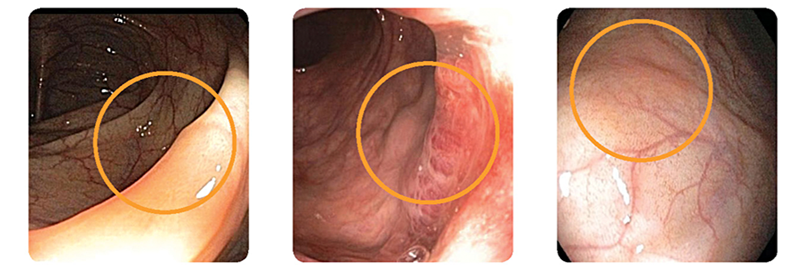
| Flat lesions | Serrated lesions | Flat polyp |
SAN ANTONIO — A higher serrated polyp detection rate was associated with a decreased incidence of post-colonoscopy colorectal cancer, according to study results presented at the American College of Gastroenterology Annual Meeting.
Joseph C. Anderson, MD, MHCDS, FACG, of White River Junction VA Medical Center in Vermont, said the serrated pathway may account for as much as 30% of CRC, but the link with serrated polyp detection rate (SDR) is unclear.
"We know that they're difficult to detect because they have flat morphology and indistinct borders. These are their characteristics," Anderson said in his presentation. "There is significant variation in published data with regard to [proximal] SDR, which is one of the rates that people will use. This spurred us to provide data to help guide recommendations for benchmark SDR."
Researchers used data from the New Hampshire Colonoscopy Registry to determine if exams performed by endoscopists who have a clinically significant SDR of at least 7% reduced the incidence of post-colonoscopy CRC (PCCRC). They defined PCCRC as any CRC diagnoses between 6 and 36 months after a colonoscopy with an adenoma detected and between 6 and 60 months after a normal colonoscopy. They also defined clinically significant serrated polyps as any sessile serrated polyp, traditional serrated adenoma, serrate polyp at least 1 cm in size anywhere in the colon and any serrated polyp greater than 5 mm proximal to the sigmoid.
In the study group (n = 142,950), investigators found 75 CRCs diagnosed in the 6 and 60 months period following colonoscopy. including 45 diagnoses between 6 and 36 months. A clinically significant SDR of 7% had a similar hazard ratio (HR = 0.37; 95% CI, 0.17-0.83) compared with an adenoma detection rate of 25% (HR = 0.45; 95% CI, 0.23-.089).
Anderson said their findings show that a clinically significant SDR was associated with a decreased incidence of PCCRC.
"These data suggest that a (clinically significant] SDR of 7% or greater may be associated with lower PCCRC rates," he concluded. -by Alex Young
Anderson JC, et al. Abstract 23. Presented at: American College of Gastroenterology Annual Meeting; Oct. 25-30, 2019; San Antonio.
Disclosures: Anderson reports no relevant financial disclosures.

About one-third of colorectal cancers may arise from sessile serrated polyps. Due to their characteristics, they are difficult to spot. By focusing on the detection of sessile lesions, Anderson and colleagues have found a correlation between interval colorectal cancers and these biologically distinct lesions. Similarly, one would expect that endoscopists who are able to identify more of these lesions will have a lower rate of interval colorectal cancers. The adenoma detection rate is a validated quality metric for colonoscopy.
The higher the adenoma detection rate, the lower the risk for interval cancer. Based on this study, a clinically significant serrated detection rate of 7% correlated with an adenoma detection rate of 25%, providing framework for what a serrated detection rate should be. The serrated detection rate is important to follow, and it should be validated like the adenoma detection rate.
Gautam Mankaney, MD
Hereditary Polyposis Center
Cleveland Clinic
Disclosures: Mankaney reports no relevant financial disclosures.
sessile serrated adenomas advanced adenomas colorectal cancer colonoscopy
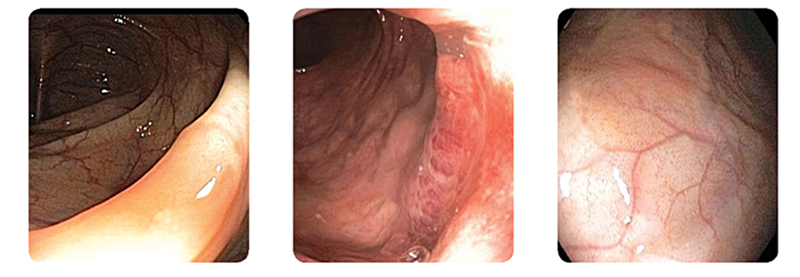
| Flat lesions | Serrated lesions | Flat polyp |
| Flat lesions | Serrated lesions | Flat polyp |
| First Exam | Second Exam | Miss rate,% | 95% CI | |
| All Adenomas | 115 | 83 | 42 | 35-49 |
| ≤5 mm | 59 | 54 | 48 | 39-57 |
| 6-9 mm | 21 | 16 | 43 | 29-59 |
| ≥10 mm | 35 | 13 | 27 | 17-41 |
| Location | ||||
| Proximal | 70 | 50 | 42 | 33-51 |
| Distal | 45 | 33 | 42 | 23-54 |
| ≥10 mm or advanced histologic features |
37 | 14 | 27 | 17-41 |
| Adenocarcinoma | 5 | 0 | 0 | — |
| 3 | 2 | 1 | 0 | |
|
3=Excellent 2=Good 1=Poor 0=Inadequate |
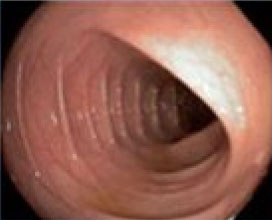 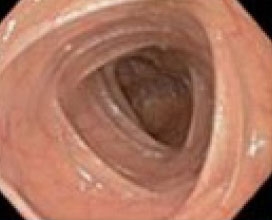 |
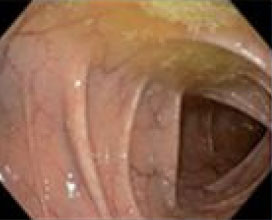 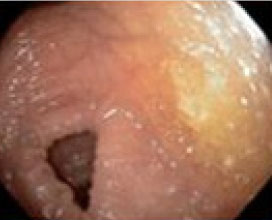 |
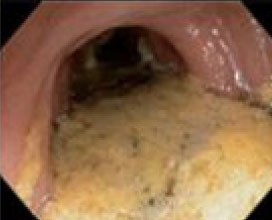 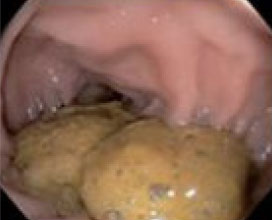 |
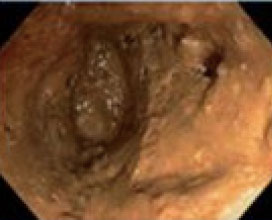 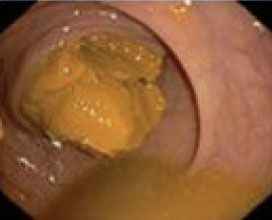 |
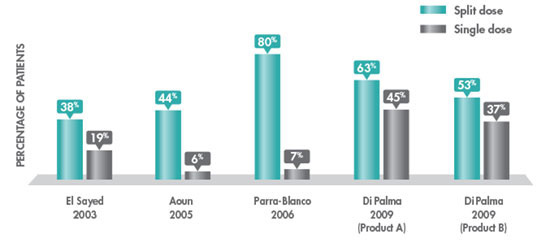
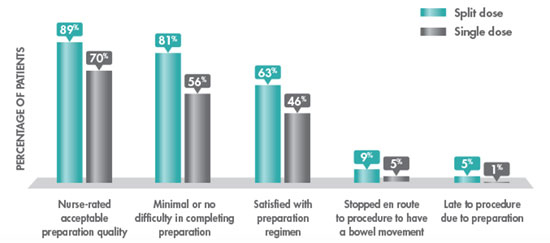
| Cecal Arrival Time,* min | Total Duration,* min | |||
| Mean | SD | Mean | SD | |
| Cleansing Quality | ||||
| Low (n=360) | 16.1 | 11.3 | 27.4 | 14.8 |
| Intermediate (n=730) | 14.4 | 9.5 | 25.6 | 13.6 |
| High (n=3,445) | 11.9 | 8.5 | 21.7 | 12.4 |
| Total (n=4,535) | 12.7 | 9.0 | 22.8 | 13.0 |
| ANOVA† | ||||
| F-statistic (2 df) | 45.6 | 45.8 | ||
| P | <0.001 | <0.001 | ||
ANOVA=analysis of variance; SD=standard deviation.
*For patients with completed colonoscopies.
†Multiple-way ANOVA with patient gender, age, group, health status, and indication for colonoscopy as cofactors.
Reprinted with permission from Froehlich F, Wietlisbach V, Gonvers JJ, et al. Impact of colonic cleansing on quality and diagnostic yield of colonoscopy: the European Panel of Appropriateness of Gastrointestinal Endoscopy European multicenter study. Gastrointest Endosc. 2005;61(3):378-384. doi:10.1016/s0016-5107(04)02776-2